
In partnership with

Welcome to Jumble, your go-to source for AI news updates. This week, a viral ad for a fictional gym called Energym is forcing us to confront a dystopian future. Meanwhile, the legal battle over AI authorship reaches the highest court in the land. Let’s dive in ⬇️
In today’s newsletter:
🤡 Satirical ad depicts a human powered future
👨⚖️ Supreme Court rules on AI generated artwork
🎖️ US military deploys Claude AI in combat
🔓 Autonomous bot breaches major GitHub repositories
📝 Weekly Challenge: Import AI chat memory with one click
🚲 This Dystopian AI Ad Has Millions Freaking Out
Belgian startup AiCandy just dropped a 40-second satirical ad called Energym and the internet can't stop watching. Set in 2036, it imagines a world where AI has wiped out 80% of jobs, crashed the stock market, and left the unemployed pedaling bikes to power data centers for the tech elite.
The kicker? It features aged-up versions of Elon Musk, Jeff Bezos and Sam Altman pitching the concept with straight faces. "What if we could use the energy of humans to power the machines that replaced them?" asks old-man Musk. Pure Black Mirror energy.
Have you seen the Energym ad?
📊 The Numbers Are Uncomfortably Real
Here's what makes it hit different: the real numbers aren't far off. Global data center electricity use is projected to double by 2030, with single facilities already consuming as much power as 100,000 households. Senator Chris Murphy said the parody feels "uncomfortably close" to current trends.

🔗 The Decentralized Pushback
In response, projects like Olas Network and Valory are pushing for user-owned, decentralized AI. The idea being that open protocols and blockchain tech could prevent a future where a handful of billionaires control all the AI power. Whether that's the answer or not, the conversation about who benefits from automation is officially mainstream.
Your AI tools are only as good as your prompts.

Most people type short, lazy prompts because writing detailed ones takes forever. The result? Generic outputs.
Wispr Flow lets you speak your prompts instead of typing them. Talk through your thinking naturally - include context, constraints, examples - and Flow gives you clean text ready to paste. No filler words. No cleanup.
Works inside ChatGPT, Claude, Cursor, Windsurf, and every other AI tool you use. System-level integration means zero setup.
Millions of users worldwide. Teams at OpenAI, Vercel, and Clay use Flow daily. Now available on Mac, Windows, iPhone, and Android - free and unlimited on Android during launch.
⚖️ Supreme Court Just Settled the AI Copyright Debate (For Now)
The U.S. Supreme Court declined to hear Stephen Thaler's case on March 2, 2026, effectively ending years of legal battles over whether AI can be listed as an author. The answer, at every level of the U.S. court system: no.
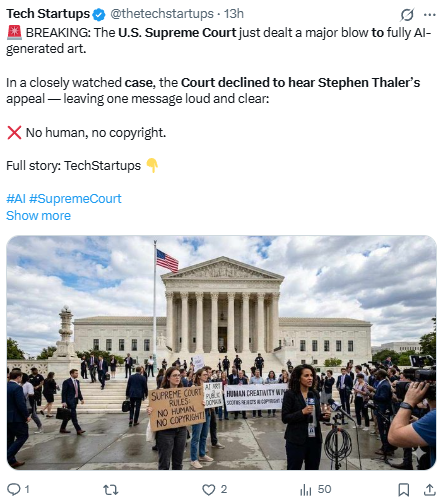
🖼️ The Case That Started It All
The case revolved around A Recent Entrance to Paradise, an image generated entirely by Thaler's AI system DABUS (aka "Creativity Machine"). Thaler listed DABUS as creator, himself as owner. The Copyright Office rejected it in 2022, and every court since has agreed: human authorship is a non-negotiable requirement under the Copyright Act.

🔮 The Bigger Picture
Critics say this could chill investment in autonomous AI content (why build it if you can't protect it?). Supporters call it a win for human creators. Either way, the line between tool and author just got a whole lot sharper.
Should AI-generated work be eligible for copyright?
Weekly Scoop 🍦
💭 Weekly Challenge: Import Chat Memories From Other Models Into Claude
Challenge: Ever wish Claude knew you like your other AI does? Now it can. Anthropic lets you import your conversation history from ChatGPT, Google Gemini, and Copilot straight into Claude's memory. That means Claude instantly learns your preferences, your projects, and how you like to work.
Here's how to do it:
📌 Step 1: Export your data. Head to your other AI platform (ChatGPT, Gemini, or Copilot) and download your conversation history. Each platform has an export option buried in settings.
📌 Step 2: Go to Claude's import page. Visit claude.com/import-memory and upload your exported file.
📌 Step 3: Review and confirm. Claude will show you what it plans to remember. You get full control to edit, remove, or approve each memory before it sticks.
📌 Step 4: Start chatting. That's it. Claude now has context about you from day one. No more repeating yourself, no more cold starts.
Bonus tip: After importing, say "what do you remember about me?" to see what Claude picked up. You might be surprised how much context carries over.
Give it a try and let us know how it went! Screenshot your favorite imported memory and tag us. 👇
Will we eventually find ourselves pedaling for our digital lives, or can decentralized AI save us from the dystopia? And, will the Supreme Court ever recognize a non-human author? See you next time! 🚀
Stay informed, stay curious, and stay ahead with Jumble!
Zoe from Jumble
